
Adventure therapy is exactly what it sounds like, and also nothing like what you're picturing.
It's not a ropes course you're forced through on a corporate retreat. It's not a reward for good behavior at the end of a treatment week. Adventure therapy is a clinically grounded approach that uses physical and experiential challenges to do the same work that happens in a therapy office, just through a completely different door. The core idea is simple: sometimes the body gets somewhere the mind won't go.
How Adventure Therapy Differs from Traditional Therapy
Traditional therapy is built on conversation. You sit across from someone, you talk, you process, you leave. That works. For a lot of people, it works really well.
But for young adults, especially those who have spent years numbing out, checking out, or just not having the language for what they're carrying, sitting in a chair and talking about feelings can feel like trying to run a program on a computer that keeps crashing. Adventure therapy bypasses that wall.
Instead of asking someone to describe an emotion, it puts them in a situation that actually produces one. Instead of talking about trust, it builds it. Instead of discussing confidence, it creates a moment where confidence becomes a lived experience rather than a concept. The body does the work, and the brain takes notes.
The Neuroscience Behind Learning Through Experience
This is not just a philosophical difference. There's real neuroscience behind why experiential approaches work, particularly for people in early recovery.
Substance use disrupts the brain's dopamine system, the circuitry responsible for motivation, reward, and the ability to feel genuine pleasure. One of the challenges of early recovery is that the brain is relearning how to produce and respond to natural rewards. Everything can feel flat, uninteresting, or just hard to care about.
Physical challenge, novelty, and accomplishment activate those same dopamine pathways in a healthy way. When someone paddles out and catches a wave for the first time, or drops below the surface on a free dive and realizes they're more capable than they thought, the brain registers that as meaningful. It lights up the same circuits that substances hijacked, without any of the cost.
That neurological engagement is hard to replicate in a traditional session. And for young adults whose brains are still developing and recovering at the same time, it can be a genuine turning point.
Why Young Adults Respond to Adventure Therapy Differently
Young adults are not just smaller versions of adults in their 40s. Their brains are wired differently. They're still in a developmental window where identity is forming, peer connection matters enormously, and learning through doing is neurologically more natural than learning through reflection.
Traditional therapy asks people to look inward before they've had enough experience to look inward at. Adventure therapy gives them the experience first, then makes space to process it.
There's also something that happens in a group setting outdoors that is almost impossible to manufacture in a clinical space.
When a group of young adults learns to snorkel together, or spends a morning on the water, they build something real with each other. Not the surface-level connection of sharing a house, but the kind of trust that comes from doing something new and uncomfortable alongside another person. That kind of peer bond is one of the strongest protective factors in long-term recovery.
What Adventure Therapy Looks Like at Momentum Recovery
Wilmington is not a happy accident as a location. Being on the North Carolina coast means having direct access to the kind of environment where this work comes alive.
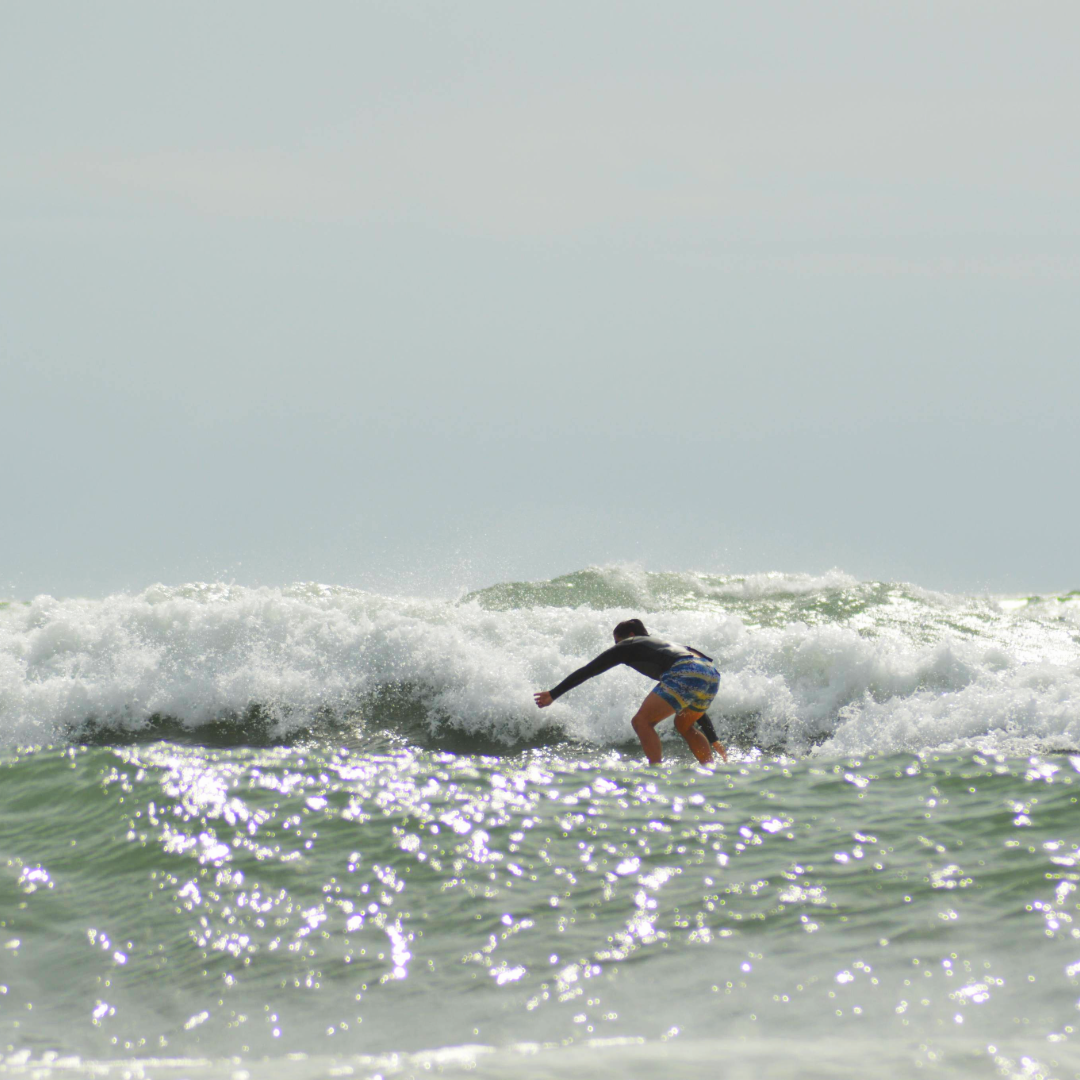
Surfing teaches you that falling is part of the process and that getting back up is non-negotiable. Snorkeling puts you in an unfamiliar world and asks you to stay calm inside of it. Free diving, at its core, is a lesson in controlled breathing, presence, and trusting yourself under pressure. These are more than metaphors, hey are skills, practiced in the water, that transfer directly to life on land.
At Momentum Recovery, adventure therapy is not a break from clinical work. It is part of it. The beach is one of our treatment rooms.
Learn more about how we work with young adults by calling us today.